
Estimate
TWD 7,000,000-9,000,000
HKD 1,728,000-2,222,000
USD 220,800-283,900
CNY 1,474,000-1,895,000
Sold Price
Signature
Signed lower right Chen Yifei in Chinese and English
PROVENANCE
Poly International Auction, Beijing, November
6, 2005, lot 1744
Private Collection, Asia
Ravenel, Hong Kong, May 29, 2016, lot 74
Acquired from the above by the present owner
PROVENANCE
Poly International Auction, Beijing, November
6, 2005, lot 1744
Private Collection, Asia
Ravenel, Hong Kong, May 29, 2016, lot 74
Acquired from the above by the present owner
+ OVERVIEW
In the early 1980s, guided and encouraged by his
artist friend Yang Mingyi, Chen embarked on an
enduring artistic journey devoted to the landscapes of
Jiangnan, the region south of the Yangtze River. In the
spring of 1984, he travelled to Suzhou and Kunshan
to paint from life. Captivated by the waterways and
scenery along the way, the artist exclaimed, “Such
an unworldly place is, paradoxically, a world of
everyday life untouched by worldly concerns.” Chen
subsequently created a series of realistic oil paintings
depicting the water town of Zhouzhuang, capturing
the region’s distinctive landscape and cultural
atmosphere on canvas. In 1985, American industrialist
Armand Hammer presented Chen’s Memoriesof My Hometown — Twin Bridges , depicting the
iconic bridges of Zhouzhuang, to Chinese leader
Deng Xiaoping during a visit to China. The gesture
became a celebrated episode in cultural diplomacy
and brought Zhouzhuang to international attention
through the artist’s vision.
Chen’s water-town paintings can broadly be divided
into two stylistic phases. His early works of the 1980s
are characterised by muted grey tones and mistshrouded
waterways, conveying a subtle sense of
nostalgia and melancholy. By contrast, his works from
the 1990s onwards feature a warmer, more luminous
palette. Golden hues intertwine with substantial
yet fluid brushwork, evoking the lyrical scenery of
Jiangnan, where the gentle rhythm of boat oars and
the tranquillity of everyday life unfold in timeless
harmony.
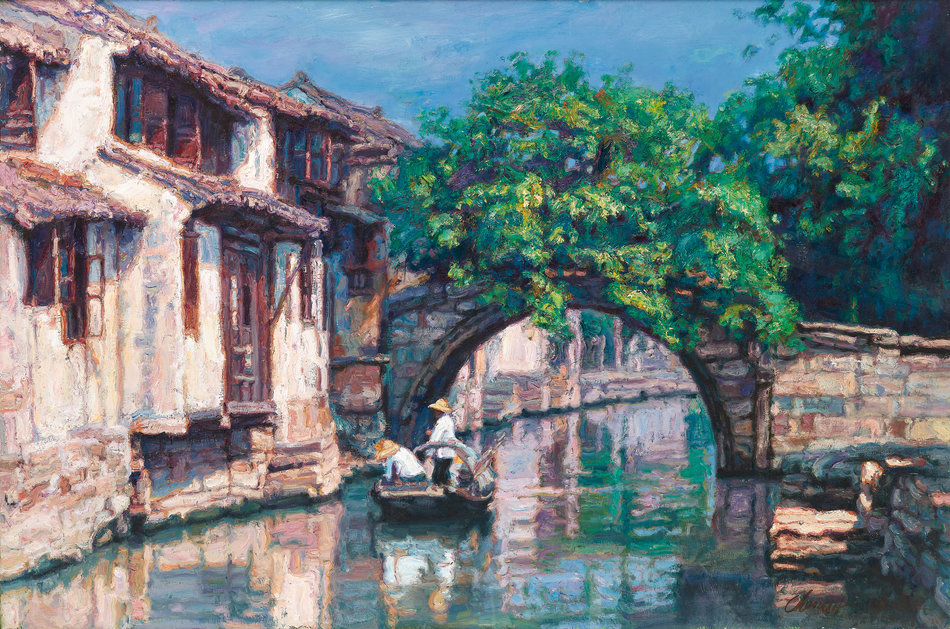
The present work, Zhou Village , is distinguished by its
luminous, warm palette and substantial yet expressive
brushwork, demonstrating Chen’s mature command
of light, colour and spatial depth. The softly rendered,
sunlit landscape is captured in a moment of profound
stillness. Winding waterways, ancient bridges and
traditional riverside architecture are brought into
harmonious dialogue, creating a poetic space imbued
with Eastern sensibility. A closer appreciation of the
details reveals the profound affection with which
Chen, living far from his homeland, depicted the
landscapes of his native China. Standing before Zhou
Village is an experience of quiet contemplation, as
though bathed in the warmth of the afternoon sun
and gazing across a dreamlike water town, with the
gentle melodies of Jiangnan folk songs seemingly
drifting through the air.Chen Yifei’s depictions of Jiangnan are more than
faithful renderings of actual landscapes; they
represent an aesthetic synthesis of Eastern cultural
sensibilities and Western oil-painting traditions.
Grounding his compositions in meticulous realism
while infusing them with Romantic sentiment and
idealised light, Chen transforms familiar waterways,
stone bridges and traditional dwellings into evocative
images that transcend the boundaries of landscape
painting. They become enduring vessels of memory,
nostalgia and cultural identity. As international
appreciation of contemporary Chinese art continued
to deepen, Chen’s water-town paintings offered a
distinctive and compelling visual interpretation of
Eastern aesthetics. Zhou Village embodies the artist’s
heartfelt contemplation of his homeland and the
enduring poetic beauty of the East, refined through
the passage of time.
Related Info
Modern & Contemporary Art
Ravenel Autumn Auction 2026 Taipei
Sunday, December 6, 2026, 1:30pm