
Lot  059 Ravenel Spring Auction 2026 Taipei

Ravenel Spring Auction 2026 Taipei

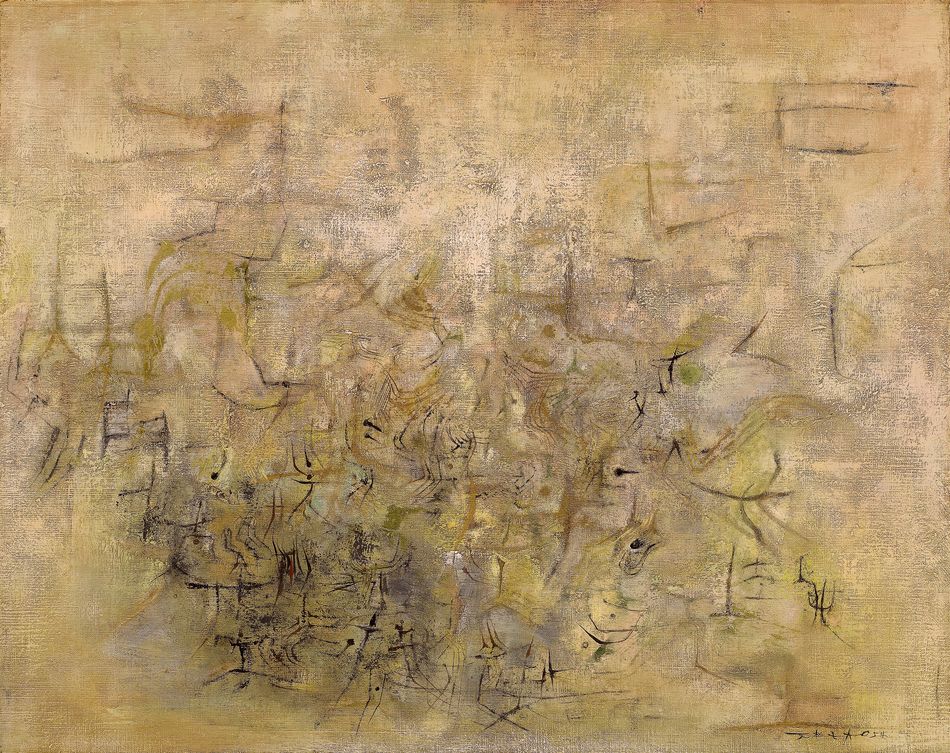
Paysage Abstrait (Abstract Landscape)

ZAO Wou-ki (Chinese-French, 1920 - 2013)

1954

Oil on canvas

65 x 81 cm

Estimate

TWD 40,000,000-60,000,000

HKD 9,804,000-14,706,000

USD 1,255,100-1,882,600

CNY 8,658,000-12,987,000

Sold Price


Signature

Signed lower right Wou-ki in Chinese and ZAO in French, dated 54

EXHIBITED
Zao Wou-ki, Lin & Keng Gallery, Taipei, March 15 - April 1,
1997

ILLUSTRATED
Zao Wou-ki, Lin & Keng Gallery, Taipei, 1997, color illustrated, pp. 28-29
Gérard de Cortanze & Yves Bonnefoy, Zao Wou-ki, La
Différence / Enrico Navarra, Paris, 1998, color illustrated,
p. 92

+ OVERVIEW

The given name of Zao Wou-ki, “Wou-ki” (無極), is rooted in Daoist philosophy, a term first articulated in Laozi’s Tao Te Ching, where it signifies the boundless origin of the cosmos and the eternal state of all existence.As one of the most influential Chinese artists of the modern era, Zao Wou-ki masterfully employed the language of Western abstraction to embody the metaphysical spirit of Daoist thought. His oeuvre, shaped by historical upheaval and cultural migration, reveals a rich evolution across distinct periods. Through subtle evocations of the universe and deeply personal experience, Zao distilled a refined synthesis of Eastern philosophy and Western artistic expression, achieving a poetic and enduring visual language. In 1954, Zao Wou-ki decisively abandoned figuration, liberating himself from the influence of Klee and immersing in the realm of abstraction with a newfound freedom and individuality. Reflecting on this pivotal transformation in his autobiography, the artist recalled: “Then, little by little, signs became forms, the background gave rise to space. Through constant reworking—erasing, repainting, beginning anew— what lay within me seemed to emerge. My paintings began to move; forms surged forth, and I dared to usecolors I had once feared.” — Autoportrait (Zao Wou-ki and Françoise Marquet, trans. Liu Li, Artist Publishing Co., Taipei, 1992, p. 104).The present work, Abstract Landscape , executed
in 1954, stands as an early exemplar of the artist’s abstract idiom. Here, one witnesses the gradual transformation of tangible forms into abstract linear expressions. Simplified motifs—still lifes, floral elements, and boat-like shapes—evolve into calligraphic signs reminiscent of ancient scripts, traversing a profound spatial field. These forms guide the viewer’s imagination toward the archaic mystique
of Shang oracle bone inscriptions and inscriptions cast on ancient bronze vessels. Fine, unbroken black lines weave across the composition, bridging antiquity and modernity, and giving rise to a quivering, luminous vitality. Layers of softly modulated color washes evoke the restrained elegance of Eastern ink traditions, while the richness of chromatic and luminous effects reflects the artist’s engagement with Western painting.
Related Info

Modern & Contemporary Art

Ravenel Spring Auction 2026 Taipei

Sunday, May 24, 2026, 1:30pm